
Thursday’s closing
A 49-year-old buyer is about to close on a two-story home in central Florida. He lives with his partner, two teenagers, and his parents fly down from the north for three months every year. The house has four bedrooms, all upstairs. One staircase. He loves the kitchen.
He closes on Thursday. Two years later, his mother falls in the street stepping out of an car. Hip fracture. The surgery goes well. Rehab is long. When she is discharged, she has to live on the ground floor because she cannot manage stairs anymore. The ground floor has no full bathroom. There is no provision to install a home elevator, not even a chase left during construction. The contractor’s quote to solve it is USD 58,000. And that, only if the main wall is not load-bearing at the exact spot where the shaft would need to go.
He signed without knowing. His architect did not raise it because the client did not ask. The real estate agent did not mention it because it was not part of the sales pitch. The bank did not flag it because it does not factor into the appraisal. Nobody did anything wrong. And still, the mistake is made.
The actual number, unrounded
A prepared home anticipates five adult life scenarios: aging, major surgery, pregnancy, temporary injury, and extended stays by elderly relatives. Resolving them at the design phase costs between USD 0 and USD 1,000. According to ILS Report, elevator structural and electrical provisions are cost-effective now, but retrofitting a finished house costs between USD 50,000 and USD 60,000.
Structural and electrical provision for a future home elevator, left in plans before construction, costs between USD 0 and USD 1,000 per unit. Minimum aligned shaft between floors: 1.10 m by 1.50 m. It is not an elevator. It is the empty shaft prepared so the elevator can be installed the day it is needed, without tearing into structure or reopening walls.
The same resolution, after the house is built, costs between USD 50,000 and USD 60,000. And that, only if the structure allows it. In many cases it does not, and the family ends up living fragmented across two floors, or selling the house earlier than they wanted. That is the figure in the title of this blog. It is not marketing. It comes from the technical catalog of the Inclusive Living Standard, based on ADA, ISO 21542, and ANSI A117.1. The complete article and structural guidelines are hosted at ilsreport.com.
You are probably already thinking your case is not that one. Your house is single-story. Or your parents are fine. Or you have not signed yet. This piece is not here to scare you. It is here so you know what gets checked and what does not before you sign.
The five findings buyers discover when it is already too late
The ILS Report, the comprehensive assessment tool that audits residential layout blueprints against the international Inclusive Living Standard (ADA, ISO 21542, ANSI A117.1), identifies design blind spots early. These systematic oversights in new residential floor plans result in substantial subsequent remodeling costs that can be completely bypassed during architectural planning.
The report, applied to new residential plans, surfaces the same points over and over. They are not failures of the architect. They are blind spots in the current review system, where nobody has the explicit task of designing the home for the next twenty years.
- Finding 1: home elevator provision not resolved. Cost at plan stage: USD 0 to 1,000. Cost post-construction: USD 50,000 to 60,000 or more.
- Finding 2: swinging bathroom doors of 80 cm. The minimum clear passage is 90 cm. An 80 cm door does not allow passage with crutches, a walker, or a standard wheelchair. Plan-stage solution: specify a pocket sliding door or a 90 cm swinging door. Cost: USD 0 to 200 at plan stage. Retrofitting later, opening the wall, costs USD 5,000 to 8,000.
- Finding 3: shower with a visible step. The difference between a stepped shower and a curbless shower (no step, linear drain) is a plan-stage decision. After construction, removing the step means redoing waterproofing, the bathroom floor, and the drain slope. Cost at plan stage: USD 0 to 500. Cost post-construction: USD 8,000 to 18,000.
- Finding 4: no structural blocking for grab bars. Blocking is the wood or metal reinforcement inside the wall, in wet zones, that lets you install grab bars safely on any future day. If it is not left in place, the day it is needed the wall has to be opened. Cost at plan stage: USD 0 to 100 per bathroom. Cost post-construction: USD 800 to 2,500.
- Finding 5: 30 cm step at the entrance with no ramp planned. Recommendation: 8% slope ramp over 4 meters of run. Cost at plan stage: USD 0 to 300. Retrofitting later, with the house occupied and partial demolition of garden or sidewalk: USD 5,000 to 12,000.
These five findings, added together, range between USD 0 and USD 2,100 if resolved at plan stage. And between USD 68,800 and USD 100,500 if resolved later.
Why your architect did not necessarily see it
Architectural design priorities focus heavily on statutory zoning, load calculations, immediate space requests, and budgetary parameters. Long-horizon domestic foresight is rarely enforced by local building codes, meaning even highly skilled professionals routinely miss future longevity criteria during standard schematic development phases.
Worth being clear. This is not a blog saying your architect is bad. Odds are your architect is good, and this happened anyway.
An architect, during a project, is coordinating between twenty and fifty simultaneous variables. Local code, structural calculation with the engineer, MEP coordination, aesthetic sign-off, area optimization, materials, budget, schedule. Long-horizon residential foresight, in most markets, is still not an explicit layer of the project. It is something some architects do by craft, others do not, and nobody systematically reviews against a unified standard.
That is what changes with an external report. It does not replace the architect. It does not argue the design. It does what the architect does not have time to do: cross-check the plan against three internationally recognized norms and return a findings sheet with exact measurements.
What the ILS Report actually is
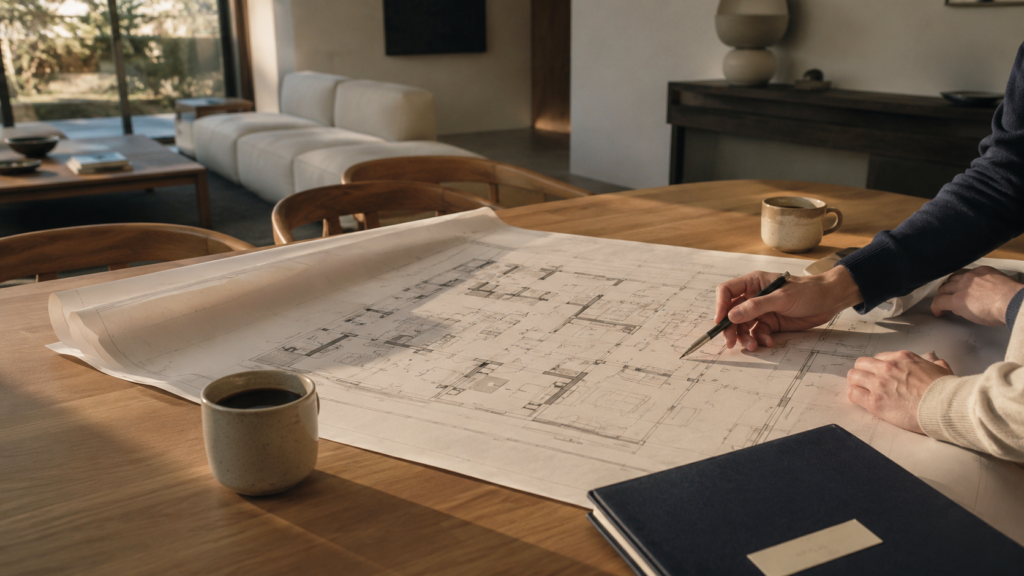
The evaluation system operates as a automated self-service platform designed to optimize building plans before construction breaks ground. Clients upload their documentation, the program cross-references the layout specs, and delivers an exhaustive digital diagnostic file outlining immediate layout corrections.
The Inclusive Living Standard, ILS, is a voluntary international standard of residential quality. Three formal certification tiers: Silver, Gold, Platinum. The report delivered for USD 99 specifically evaluates the “prepared” level: how far your home is, at plan stage, from reaching Silver and from carrying the provisions for Gold.
What you receive:
- A PDF that evaluates the plan against the standard.
- A numerical ILS Score from 0 to 100.
- Findings by critical zone: entrance, bathrooms, kitchen, circulation, stairs, bedrooms, electrical, lighting, yard, pool.
- Each finding comes with three elements: what was found, why it matters for real life, and what to do to resolve it at plan stage before construction starts.
Turnaround: under twelve hours from PDF upload. No sales contact. No salesperson calling you. You upload, pay, receive by email.
What happens after you read the report
Future homeowners employ these technical insights to integrate critical structural shifts prior to signing builder agreements. The data functions as an objective assessment that streamlines technical discussions with contractors and real estate developers to secure property longevity.
Most buyers who receive the report do one of three things.
They send the PDF to their architect and ask them to evaluate which changes to incorporate and which to document as conscious decisions. The architect receives it well, because it is not a critique, it is an external technical input. The conversation becomes more professional, not more confrontational.
They send the PDF to the developer, if they bought pre-construction, and ask for corrections to be incorporated before closing. In serious projects, the simpler corrections tend to be accepted without debate because marginal cost is low and added asset value is high.
They decide not to sign, or they renegotiate price. It is the least common response, but it happens. When findings are too many and too expensive to correct, the buyer uses the report as a negotiation argument, or walks away and looks for another option.
Frequently Asked Questions
Do I need to have the complete plans to upload them? Not necessarily. The report works from approved architectural plans or a detailed schematic design. The more complete the plan, the deeper the analysis. With a basic plan the major findings come through; with construction documents the minor ones also surface.
Does the ILS Report work if I have not signed yet? That is the best moment. The optimal window is between the time you have the plans in hand and the closing date. Any finding within that window is negotiable. After closing it still works, but you move from negotiating to solving.
Is this the same as asking for an accessible home? No. Asking for an accessible home triggers a medical imaginary that does not apply to a residential home prepared for every life stage. The ILS standard evaluates a home that works for a leg in a cast, a pregnancy, an extended family stay, an outpatient surgery, and eventually for age. It is foresight, not adaptation.
Will my bank value the ILS Report in the appraisal? Not yet broadly. In mature markets it is starting to appear as a factor in premium second-home appraisals. The curve is the same energy certification had fifteen years ago: starts voluntary, ends required.
How much does it cost and how long does it take? USD 99. Under twelve hours from plan PDF upload. Self-service on the platform, no commercial contact.
Get my ILS Report · USD 99 ilsreport.com